


Aviation business is subject to high safety measures but accidents may still happen during flight. The emergency landing of the TUI Airways Flight BY6754 is one such instance that particularly attracted a lot of attention because of the quick escalation just after takeoff. It is an overview of the event, causes, response and impact on the passengers, and the overall implications on aviation safety in a comprehensive, professional and SEO-friendly manner.
May 2014 Flight BY6754 at TUI Flight.
TUI Flight BY6754 was a planned commercial flight flown by TUI Airways that was flying between Cardiff Airport and Paphos International Airport. The flight was made possible with a groundbreaking narrow-body jet that was a Boeing 737-800 which is characterized by dependability and efficiency.
But due to a technical problem, a short time after takeoff the plane had to declare an emergency and divert.
How It Happened: Timeline of Emergency.
The events took place during a September 28, 2025, serious incident a few minutes after takeoff. At the initial climbing stage, the aeroplane had a serious issue related to the engines. As aviation reports say, the pilots had a short time realizing how serious the problem was and stopped the ascent.
As a precaution, the plane went on hold, flying round the Cardiff airspace. The crew members then proceeded with the usual emergency practice, meaning declaring a signal of distress i.e. waving a distress coded signal, that is a universally accepted signal, the squawk 7700 signal, which signals any distress on the board.
The pilots missed Cyprus and redirected the flight to Birmingham Airport that was more suitable to handle emergency landings.

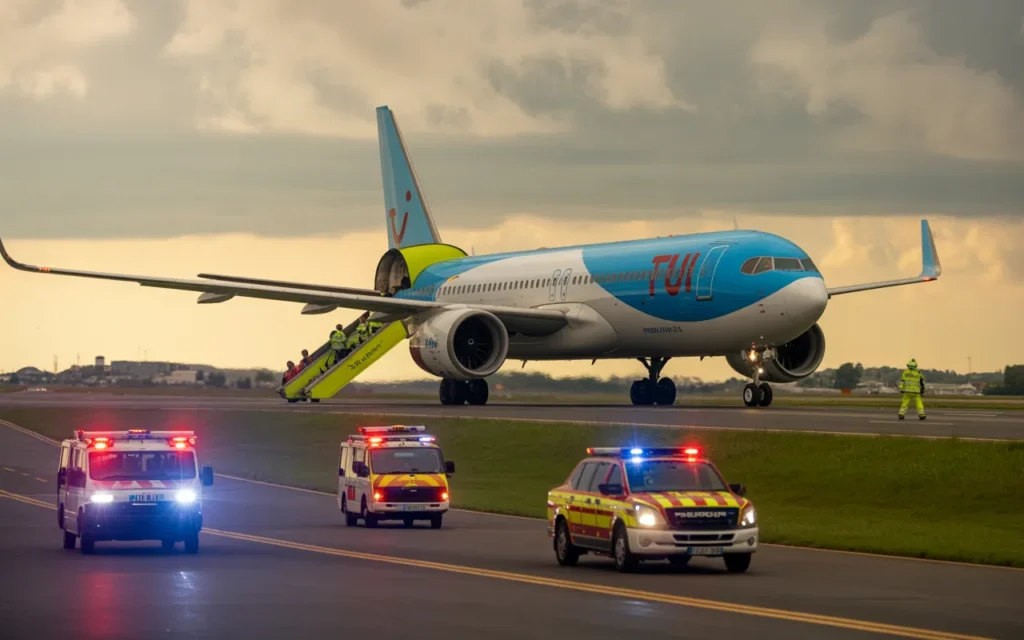
Emergency landing at the Birmingham Airport.
Having circled to conserve fuel and stabilize the aircraft, the flight was heading towards Birmingham. Standard aviation safety protocols had emergency services such as fire crews and medical teams in standby.
The plane safely landed around 5:29 PM BST, almost an hour after departing. There were no injuries to passengers and the crew, so it proved the success of both crew training and emergency response coordination.
Flight activities at Birmingham Airport were even halted temporarily in order to focus on safe landing showing the gravity of the situation and the concern that the airport has on safety.
Reason behind the Emergency.
The main reason behind the emergency was termed as an engine malfunction. Other reports associated the problem with a potential bird strike soon after take-off, which may cause engine damage or a decrease in performance.
Among the most important challenges in aviation is the role of engine-related incidents that directly affect the capacity of an aircraft to maintain the ability to stay up in the air and at the speed. But with current planes such as the boeing 737-800 they have been engineered to be safe enough to fly even after one engine has been lost as long as the right procedures are adhered to.
Pilot Response and Crew Performance.
The prompt response of the flight crew who made the correct decision as a result of professionalism is credited with the successful outcome of BY6754 incident. The pilots also took important measures which included:
- Quick diagnosis of the engine problem.
- Giving standard aviation codes to declare an emergency.
- The control of flight by figure-eight maneuvers.
- Choosing the safest option of airport.
Liaising with the air traffic control and emergency services.
Such procedures are in compliance with international standards of aviation safety and they are indicative of why commercial air transit is among the most secure means of transport.
Passenger Experience and Impact
There was a tense situation witnessed among passengers onboard, particularly when there was the first emergency declaration and undoing round. Nevertheless, anxiety was managed because of effective communication by the crew, which kept the order.
Upon safe landing, the passengers stepped out safely. In such instances airlines are normally helpful including:
- Rebooking of other flights.
- Accommodation (if required)
- Compensation depending on regulations
Despite this disruption in the journey, safety of the passengers was not disturbed.
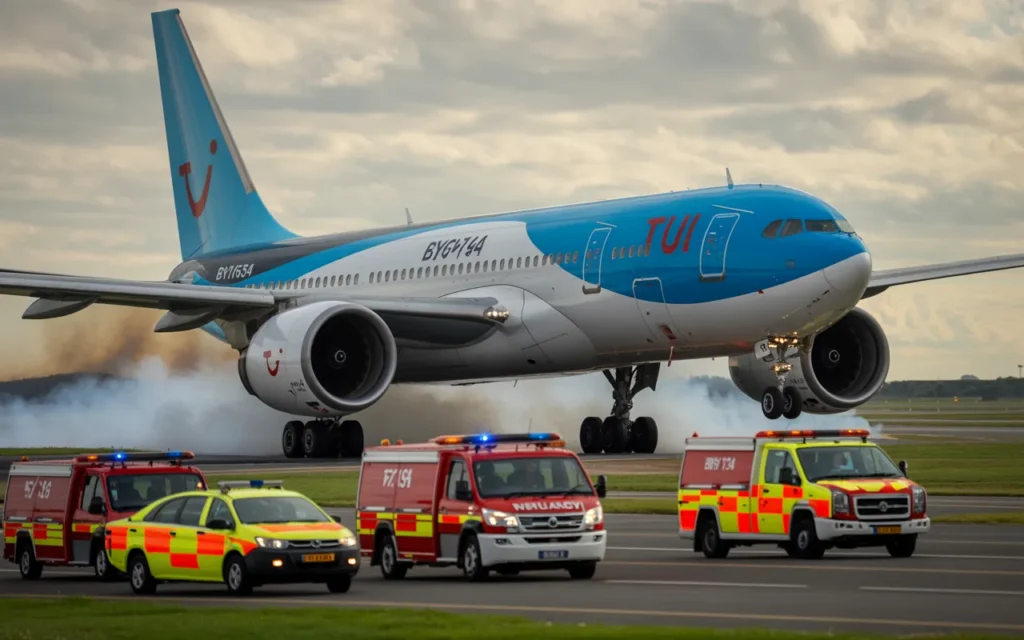
Safety Aviactions on the Ground.
The event underscores the interaction of several layers of aviation safety with each other:
1. Aircraft Design
Modern aircraft is enhanced in such a way that it can deal with operating failures such as engine failures without being disastrous.
2. Pilot Training
Pilots are also trained in emergencies such as engine failure on rigorous simulations to guarantee speedy and correct reaction.
3. Air Traffic Control Coordination.
Controllers are important when it comes to clearing of airspace and route of safe landing of planes.
4. Airport Emergency Preparedness
The airports have emergency response teams, which are always on hand to respond in a few minutes.
Broader Implications for the Aviation Industry
The TUI Flight BY6754 emergency landing is interfering with the following key lessons:
- Saving lives: The standard procedures provide safe results even in the serious cases.
- Technology improves safety: With the improved monitoring systems, it is possible to identify problems before they arise.
- Reorganisation is the first one: It is imperative to make a smooth communication between pilots, ATC, and ground crews.
Although these happenings are rare, they make good case studies in enhancing the safety systems in the world.
The reasons why emergency landings can work.
Although the occurrence of in-flight emergencies is alarming, most of them are successfully terminated because of:
- Redundant aircraft systems
- International safety standards.
- Continuous pilot training
- Monitoring and communication in real-time.
In BY6754, all these factors came into play to avert what could have been a much more serious situation.
Conclusion
The TUI Flight BY6754 emergency landing can be regarded as an eloquent illustration of aviation safety in practice. What was initially one of the potentially serious engine problems soon after takeoff was successfully handled by the use of professional decision making, advanced aircraft design and the organized emergency response.
There were no injuries, and the landing of passengers and the crew were safe, which once again proves the superiority of the current aviation systems. This kind of incident can lead to a short-term worry, but it eventually reinstates trust in the industry to deal with cases of emergencies accurately and with caution.