


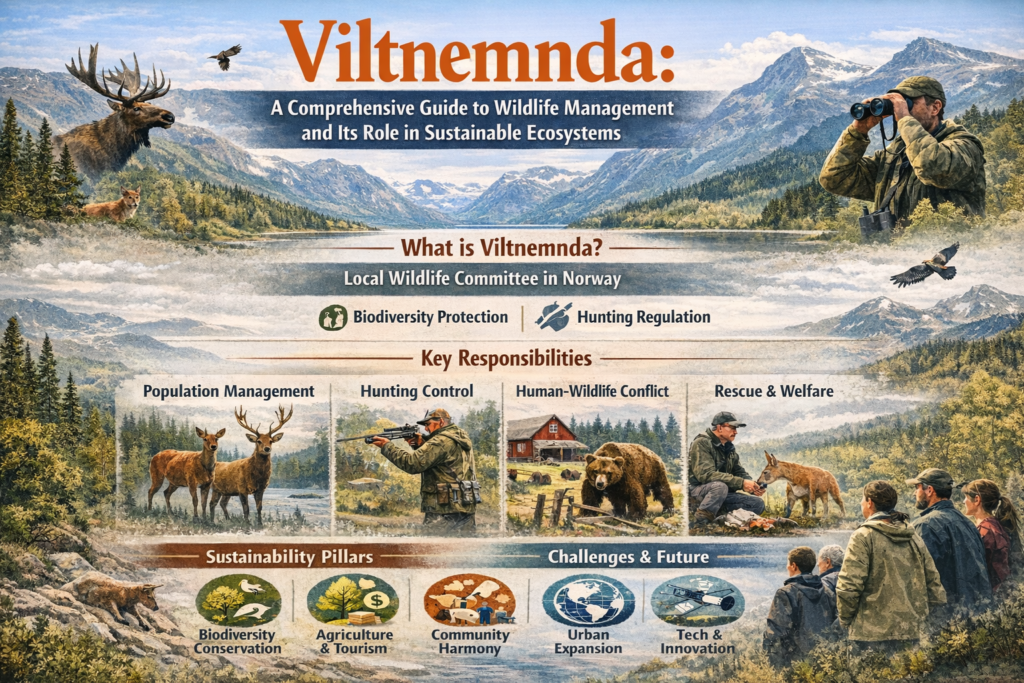
One of the biggest problems when it comes to environmental sustainability in the contemporary world is the management of wildlife. As human populations are growing and the natural habitats are becoming degraded even more then there is even less of a chance to strike the balance between ecological protection and human activity. Largely, Norway has likely one of the most localized and successful systems of addressing this issue: the municipal wildlife management committee Viltnemnda that has been at the forefront in ensuring biodiversity and sustainability of the ecosystems.
It is an elaborate map to the shape, functions and importance of Viltnemnda and how it can help in the present management of wildlife and how it can be used as a valuable model of sustainability in the world.
What is Viltnemnda?
Viltnemnda means wildlife committee in Norwegian and is a municipal-level body that deals with the wildlife in the local areas. In contrast to centralized systems, Viltnemnda is at the community level where decisions can be made to suit the local ecological status and needs in the society.
Norway has a single Viltnemnda in each municipality, which is chosen by the local authorities. These committees act as a linkage between national environmental regulations and local execution, thus making the policies on wildlife to be scientifically based and practical.
Law and Regulation.
Viltnemnda is governed by two main legislations:
- Wildliving Act (Viltloven): Focuses on the law of hunting, use of livestock and population control.
- Nature Diversity Act ( Naturmangfoldloven): Has put a stress on preservation of biodiversity and sustainable management of the ecosystems.
These legislations also ensure that the entire wildlife management activities are informed by the concept of sustainability, scientific studies and morality. The decentralized system enables the municipalities to adapt national policies to local environmental realities and consequently the system is very responsive and efficient.
Key Responsibilities of Viltnemnda
Viltnemnda has many applications in wildlife management. Its activities are not only related to conservation but also to the safety of the population, education and conflict management.
1. Wildlife Population Management
Regulating and controlling the population of wildlife is one of the key responsibilities of Viltnemnda. This involves:
- Carrying out survey, gathering ecological information.
- Ensuring equilibrium of species like moose, deer and predators.
- Avoiding excessive population and environmental unbalance.
Viltnemnda allows the population to stay stable, thus preserving ecosystem well being and avoiding depletion of resources.
2. Hunting Practice controls.
Wildlife management in Norway is linked with hunting, which should be regulated. Viltnemnda:
- Establishes hunting limits on a yearly basis.
- Establishes seasonal restrictions
- Firms up ethical hunting activities.
These actions will make hunting sustainable and not jeopardizing the biodiversity.
3. Managing Human-Wildlife Conflicts
Human-wildlife conflict is an increasing problem in the world. Viltnemnda deals with such problems as:
- Crop damage caused by animals
- Livestock predation
- Mechanical road accidents with wildlife.
The committee serves as an interpreter between the stakeholders, guaranteeing the development of solutions that safeguard human and animal interests.
4. Wildlife Welfare and Emergency Response.
Viltnemnda frequently responds to wildlife crises. This includes:
- Assisting injured animals
- Control over wildlife road accidents.
- Co-ordinating with police and local authorities.
This emergency reaction system boosts the security of communities and protection of animals.
5. Environmental Education and Awareness.
In addition to regulation, Viltnemnda is also important in enlightening people. It promotes:
- Knowledge of the significance of biodiversity.
- Careful handling of wildlife.
- Sustainable land-use practices
This teaching method promotes the culture of environmental responsibility in societies.
Organization and Process of decision making.
Viltnemnda consists of locally appointed people and may include:
- Wildlife experts
- Hunters and landowners
- Environmental professionals
This heterogeneous composition guarantees that the decisions are moderate and put into account various viewpoints. Members also know local ecosystems and as such can produce solutions which are unique and may not be achieved by centralized systems.
The decision-making process often includes data analysis, consultation with the stakeholders, and compliance with the legal requirements. This is a systematic method which finds accuracy and responsibility.
Role in Sustainable Ecosystems
The work of Viltnemnda is closely related to the idea of sustainability. Its strategy is aligned to three pillars:
1. Ecological Sustainability
Viltnemnda assists in preserving biodiversity by controlling the number of wildlife and conserving their habitat. Balanced ecosystems are better equipped to withstand changes in the environment, such as climate change.
2. Economic Sustainability
Wildlife management has a direct bearing on industries like:
- Agriculture
- Forestry
- Tourism
Viltnemnda helps to stabilize the economy through limitation of damages made by wildlife and encouragement of regulated hunting.
3. Social Sustainability
Viltnemnda guarantees a coexistence between people and wild animals. Its methods of conflict resolution enhance peace, minimizing the conflict between communities and conservation.
Challenges Facing Viltnemnda
Viltnemnda is experiencing a number of contemporary challenges in spite of its efficiency:
Climate Change
Alteration in climates influences the migration patterns, breeding cycles, as well as availability of habitat making management of wildlife more complicated.
Urban Expansion
With the rise in population of cities, the natural habitat decreases and human beings come into more contact with wildlife, heightening hostilities and clashes.
Public Perception
A compromise between conservation and hunting and population control may be a controversial issue that needs to be communicated and made transparent.
Resource Limitations
Local committees have the possibility of being limited to funds and staff, which reduces their efforts in the management of wildlife.
Viltnemnda has a global relevance.
Viltnemnda is perceived as an example of decentralized wildlife management. Its success shows the value of:
- Local governance
- Community involvement
- Science-based decision-making
This system can be used by countries with similar issues to learn to adopt localized solutions that incorporate national policies with local needs.
Wildlife Management Future.
Innovation and collaboration are the future of such systems as Viltnemnda. Emerging trends include:
- Use of technology for wildlife tracking
- Data-driven conservation strategies
- Increased international cooperation
With the adoption of these developments, Viltnemnda will be able to keep on developing and be able to face the upcoming environmental challenges.
Conclusion
Viltnemnda is a good illustration of how localized governance can help in achieving global sustainability objectives. It maintains a sustainable balance between ecological conservation, economic and social harmony so that the communities of wildlife and human beings live together.
With the environmental issues becoming ever more complicated in an age, community-based, science-focused wildlife management systems such as Viltnemnda are becoming more significant. Its achievements highlight one important lesson: local knowledge, legal frameworks, and environmental responsibility are most effective to protect sustainable ecosystems.
FAQs
1. What is the meaning of Viltnemnda?
It is a Norwegian municipal wildlife committee that deals with local wildlife.
2. What is Viltnemnda important?
It guarantees sustainable management of wildlife, ecosystems and solves human-wildlife conflicts.
3. What is Viltnemnda doing to facilitate sustainability?
Through regulated hunting, the conservation of biodiversity and co-existence between humans and wildlife.
4. Will other countries be able to follow this model?
Yes, the decentralized model can be scaled to work internationally to enhance local wildlife management systems.